
 Birds sing

And roads slide towards the Pacific


 With the exception of the couple of dozen tourists per day, the plateau's economy is entirely agricultural. Women go to wells and carry water for miles,
 and the men fish the lakes (or more probably old palace fish ponds) in small boats or just casting their nets standing in the muddy water up to their chests. In a sign of modernism, they arrived at the pond 3-4 on one Honda Hero motorcycle at a time.
 Mandu had the friendliest and most open people I met during the trip. Nobody begged, I got invited to sit down with a family when I walked out to the fish pond in the morning...I very selfishly hope that nobody improves the road there anytime soon. As it was, the bus almost didn't make it through one of the gates.


 Mandu, nowadays a tiny town of 8000 and 50% literacy the end of the road, was the Raj and Afghani capital of a large part of northern India for a few hundred years. Like Orchha, it is in the middle of nowhere--at least this time for a good reason its 23 miles of walls and battlements sit on a mountain ridge that make the place both cooler, and pretty hard for mounted troops to assault. Also like Orchha, only the amazing palaces,
 mosques,
 caravansaries and graves are left...no sign that normal people lived here. I'd so love to start an archeological dig here.
 The Afghani palaces are of unbelievable splendor surrounded by huge artificial lakes and water tanks--both because of the erratic supply and to make the 120F summer heat more bearable.
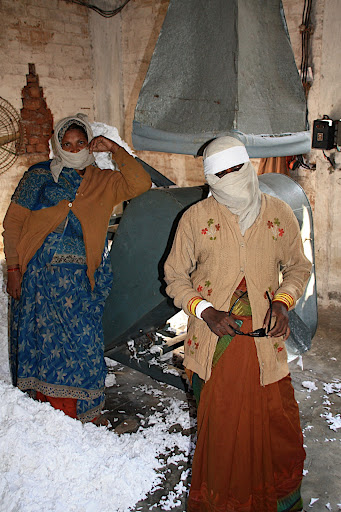
 The Ship Palace, so called because it sits between a lake and a water talk like a huge ship was undergoing restorations...from the concrete mill below, the building methods haven't changed much since antiquity.
 The great audience hall, stripped of the carpets, gold and decorations...and still very impressive.


 Sorry about the image quality. This was shot off a bus bouncing along what was euphemistically called a "main road".


 The evening has some additional appeal like the candles floating down and the glowing pyres, but the silence is scattered by the huge evening religious ceremonies piping prayers through loud speakers.
Great planning in India, part 21498: On new years day, the road department painted a huge "Happy New Year 2009" across the always congested main road. Then they roped off the two lanes around the inscription, completely choking off traffic.


 Even the electrical installation and switchboards were 19th century originals.

 The second night in Orchha was Christmas Eve and the hotel pulled out all the stops by hiring a illuminated dance floor and a DJ. If you've never celebrated the birth of the savior by rocking out to Who Let The Dogs Out in Hindi, you haven't experienced the true spirit of Christmas. Our tour guide--who wiped out on a motorcycle the night before--greatly enhanced the production value by demonstrating why you shouldn't mix pain meds with alcohol: He break danced through three or four repeats of the one and only 80s dance CD the DJ had handy.

 After Delhi and Agra, we dropped off the beaten path with an all day bus trip to Orchha (oh my arching butt) on one of India's main roads. A few hours into the shake rattle and roll, we reached Gwalior (pics), and its incredible fortress. The few other tourists were Indian, and it was manned by only a single hustler. Well, given the road to Gwalior, maybe not so surprising, after all.
 Just for starters, the walls are 3 miles long and more than 30 feet high on a plateau. The mix of Raja and Mughal architecture is is amazing, and in places incredibly playful. I've never seen a ruler who would voluntarily tile his palace with yellow ducks.
 Large parts of the palace are unfortunately not open to the public--or in a state where one could count on the ceiling not carving in, but the even the accessible parts on their own were just about my favorite building in India. The staircases into the bowels of the fort not so much, though.
 Like all other palaces, there are no glass windows because of the warm climate. Instead, intricate screens are carved out of stone.
 After lunch, we watched the inevitable first bad accident when a car ran into a biker*. From then on, we got one per day which makes me doubt the official number of "only" 12,000 people dying in traffic every year.


 The first "real" Indian city we went to, Delhi is just so much larger that a number of things don’t apply in the same way. Of course, thanks to the Taj Mahal, it is also the largest or second largest tourist attraction in India, so not all things that apply to similarly sized cities like Bhopal and Indore are also true in Agra.(pictures)
 It is unlike anything you see in any other part of the world: entire halls made of solid marble and inlaid with semi-precious stones, filigreed windows screens carved out of one piece of marble or sand stone, and much more jaw-droppingly beautiful design.

After the fort, three others and I took our first TukTuk to ride out to the so-called Baby Taj. TukTuks are marginally less terrifying than rickshaws. Due to congestion, they also drive slower than their Thai or Peruvian equivalents, but are prone to more abrupt maneuvers, since Indian traffic is even more unpredictable that Thai. The sights include all kinds of animals, children playing real life Frogger, and the occasional dead body being carried on a stretcher.
At the big traffic circle in front of the main bridge, we ran into a particularly ingenious method of traffic control : a few cops standing in the middle of the road and deciding on the fly which lane should move. If a driver ignores the signals—which commonly happens—they don’t hand out tickets, but just hit the vehicles hard enough with their lathis (5 foot bamboo batons) to put bumps into cars and raise welts on cyclists.
In a sign we overpaid for the TukTuk ride, our drivers were eager to wait for an hour until we finished visiting the Baby Taj.
The Baby Taj is the most singularly beautiful building I have ever seen. It is far smaller than the Taj Mahal, but while the Taj seems pretentious, the baby is of exquisite craftsmanship and impeccable design. It seemed even more improbable after we visited a inlay factory and heard that creating a dinner plate sized piece can take a skilled worker a month—I can’t even calculate how many man hours did go into doing this on a 50 by 50 foot building.
On the other hand, semi-domesticated water buffalo were fording the river right in front of it.
After the Red Fort and the Itmad, the Taj, although much larger and probably Asias most iconic building, was a bit of a letdown. The walls are plain marble inlaid only with some large Koran quotations, and very sterile. No wonder Shah Jahan’s son disposed him soon after the building was finished and nixed the plans for a sister building made of black marble.
“FOOOOOCK!!!”—Rudely catapulted out of her seat by one of the frequent illegal speed bumps Indian villagers love to put on the main roads, my fellow traveler resumed viciously cursing the Indian roads, the bus’s broken suspension, collapsed upholstery, and the mechanic who removed all the shocks a few decades ago in Flemish, French, and English.
We are on day 3 of our Indian trip, and the first one with a hundred or so miles of Indian highways. It lacks the complete terror of one’s rickshaw cutting off a city bus, the confusion of the same rickshaw weaving through Old Delhi backroads scarcely wider than the vehicle, but adds the extreme discomfort of getting shaken hard enough to dislodge luggage and kidneys. It also goes a long way to explain why the main mode of inter city transportation in India is by train.
Indian trains are slow and crowded, but—except for the last day—more punctual, friendlier, and cleaner than anything Amtrak puts out. You board, settle back in your seat, let the landscape pass by and wait for the chai, coffee, or food wallah to serve you. The food is dirt cheap at about 40cents for breakfast and a dollar for most full meals. Also, when the train stops somewhere out in the open (which happens a lot, because of single lane tracks and no computerized scheduling), it only takes minutes for the kids from the nearest village to grab all available foods, bang on the doors and board the train to sell it until the train starts moving again or they get kicked out by the dozens of railway employees.
Service is an admirable 24-7, the constant shouts of “chai”, “coffee”, “meal” of the wallahs make sleeping somewhat of an art form, though.
Getting to the train is a completely different experience, though. All the stations we went through have seen minimal changes or improvements since the end of the Raj, and are overflowing with people, cows, and various other animals. When leaving Delhi, some workers were resurfacing the platform right between the passengers. The SOP is:
Rinse, lather, repeat. Trains are commonly late, really late, not late like Japan's Shinkansen "annual average of 6 seconds" late. And this being India, obviously nobody in the station hierarchy has any idea when they might finally leave, so many Indians camp out on the platforms. One woman told me that she’s been waiting for 16 hours when I boarded the Super Express train from Veranasi to Delhi. By the time we got to Delhi, the super express delay had balloned to 27 hours, turning what was supposed to be a 12 hour trip into a two night ordeal.


