Thursday, August 21, 2008

George Balmer

The WSJ reports that Microsoft is hiring Jerry Seinfeld to make the brand more hip.

Makes sense....

Sunday, August 17, 2008

Lost Coast

I spent the weekend hiking and driving around California's Lost Coast (pics), so called because the King Range is so rugged that almost no roads lead through it. Even Hwy 1 and 101 veer about 30 miles inland. Full of redwoods, black beaches, dead whales, and the last of the formerly famous weed farmers until they got pushed out of business by the Sierra plantations of Mexican drug lords.
Shelter Cove, the south end of the Lost Coast Trail
Lighthouse Beach near Petrolia in the centerThe hide of a dead sparm whale, the tail fin in the foreground, some vertebrae to the left, a spinal disk sitting right in the middle, and you can see the tooth holes in the upper jaw. About 45 feet long, so either a small or a young one. The smell is not as revolting as week old sea lion, but there's more to go around. Upwind isn't bad, but I could smell it downwind for the next half hour or so.Back to civilization: Victorian in Eureka

Thursday, August 14, 2008

I am in awe of Bill's political genius

It took me a while to figure it out, but now I can predict the Democratic convention down to the tiniest detail.

Monday, August 25th
Seating of the delegates for Florida and Michigan.

Tuesday, August 26th
Rumors about a "big impending Obama scandal" start to circulate on the convention floor and will get picked up by the MSM. Hillary will go out of her way to defend BO. Bill will dismiss the rumors, but point out that "young, unproven candidates have to endure more scrutiny" .

Wednesday, August 27th
Bill Clinton gives the defining 21st century version of Marc Anthony's "Friends, Romans, Countrymen" speech. Florida, Michigan, and one Obama state will declare for Hillary. Hillary will dismiss this as ridiculous, endorse Obama, and state that she will obviously do anything to preserve party unity and "do anything to serve the Democratic cause."

Thursday, August 28th
More scandal rumors surface on Drudge Report and FOXnews. Hillary will take the stage and declare that "She is prepared to accept the nomination and enthusiastically welcomes Barak Obama as our next Vice President." Texas declares its intention to 'respect the will of the majority of Texas voters' and switch the votes of the caucus delegates.
Super delegates vote for Hillary in order to "preserve party unity and bring about the change this country so badly needs".

Sunday, August 10, 2008

Gravity was last seen riding a stolen motorcycle on I-80


The Americans have no respect for their language, and will not teach their children to speak it. -- George W. Bernard Shaw

Thursday, August 07, 2008

Machu Picchu

Someone just reminded me that I never finished my Peru posts, and--more egregiously--left out Machu Picchu so far.

For some reason, Blogger doesn't let me copy images from my gallery right now, so click here for some pictures


So, Machu Picchu...I'm still sorting out my feelings about that one, but all in all, I didn't quite get the kick out of it that everyone I've talked to before and after seems to have gotten. Part of it is that it's so overwhelming, another probably that after almost two weeks in Peru I was a bit worn out, part was a Chicha and "whatever was in that bucket" hangover, but most of it was that there was no there there. I love history and archeology, and while Machu Picchu is spectacularly situated and impeccably built, there is only very little tangible history here. Unlike Pisac, or Greek ruins, or the Anastazi sites, it was probably abandoned shortly after it was built, and maybe never fully inhabited, so it is lacking all these very little clues and imprints of the people who lived there.

One example of what I mean is this building in Mesa Verde.
Nowhere near as impressive as Incan buildings, but it tells a story, and might help to unlock a mystery. On the left side, the masonry is of better quality and the balcony is held up by double wood braces. On the right, it's held up by single braces. One possible interpretation, supported by carbon dating and placing the trees further away than ones on the left, is that the right side was build during the decline of Mesa Verde after they cut down all the easily accessible trees. It supports the theory that the rapid vanishing of the entire culture was caused by overpopulation, overuse of natural resources, and apparently a devastating drought in what was marginally arable land in the first place.

Anyway, Machu Picchu. Since there is no road leading to Machu Picchu the train ride from Ollyantaytambo, the only access is by train through an unbelievably scenic, narrow, and steep river valley. The trains are fairly new, but move slowly because the drivers have to get off every few miles to set and reset the switches by hand. Aguas Calientes (freshly renamed to Machu Picchu Pueblo) is the only town within miles and consists of the hotels, hostels, and backpacker haunts north of the river, and the houses of the guides, maids and cooks on the other side. For Peruvian standards it's very affluent, and has a reputation as the most expensive part of the country. If you've been to a mid-range Mexican or Italian resort town, you know what it looks like.

Accordingly, I dropped my stuff in the hotel, hooked one guy up with Neosporin and a first aid kit, and went back south to buy some water and snacks for the next day. They turned out to be cheaper than in Ollyantaytambo, which shows what guidebook writers know.
Fortunately, I ran into the preparations for a parade in honor of the anniversary of the World Heritage Site status. So I watched the an amazing display of Peruvian organization and efficiency during the two hours it took them to set up the marching order while getting steadily drunk on homemade corn beer (chicha) and moonshine--both served for pennies by some nice kids in front of the stadium. I didn't bring my camera, but it seemed wrong to take pictures anyway. It was a wonderful show nevertheless with everyone outfitted in local costumes, or Incan fakery. After that, it was dinner, a few more beers, Excedrin, a few hours of sleep, more Excedrin, breakfast, a 30 minute bus ride up dozens of switchbacks and a 5AM schlepp up to the highest point in Machu Picchu for an incredible sunrise over the Andean mountains.

Our local guide did a great job explaining and showing the place to tired and giddy tourists, and then we had many hours to explore and take hundreds of pictures (I clocked about 450 and wasn't even close to the crown). Architecturally, and from the 'how the heck did they get this up here', it's unbelievable. Another strong impression was the organization and the clear social differences: you can tell with one look at the masonry if workers, artisans, or members of the priest and ruling class lived in a building or area. Even after almost 600 years, the stones still fit tight, the stairs are still in place, and if you'd put up a few roofs, you could move right in. What makes the widespread lack of signs on habitation even more eerie.

Anyway, pictures tell the story better than words can.

(Side note: for all their wonderful architectural accomplishments, building consistent stairs was not one of the Inca's stronger points. They range from uneven to rockfall everywhere except in Sacsaywaman.)

I spent close to eight hours exploring in and around, interrupted only by a 45 minute nap on one of the big grass covered terraces to catch up on sleep and metabolize the rest of the moonshine.

Wrap up in a few days.

Sunday, July 27, 2008

Sacred Valley


OK, back to Peru and possibly the best vacation day I've had this decade.

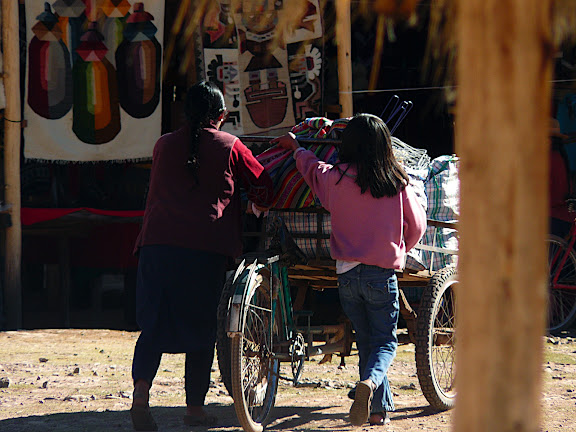
The three of us who were weren't either on the Inca treck--or recovering from having been ferried down from it on burros while passing out from altitude sickness--had a leisurely breakfast at 5:30am, and rolled out with the professor-guide and yet another best-driver-in-Cusco in a brand new Hyundai truck that had some kind of radar that lets you overtake other cars right ahead of blind curves.Today’s trip took us over the pass behind Saksaywaman to the Sacred Valley, the center of Incan agriculture and the fortress cities of Pisac and Ollyantaytambo. First stop was a tourist market, which was actually fascinating since we were there hours before the hordes of other tourists whose tours didn’t eschew meaningless amenities like sleep or breaks. So we saw the traders coming in on bicycle rickshaws, or with their children pushing carts with their merchandise.As a side note, even though the rural areas of Peru a desperately poor, we didn’t see any beggars, or any malnourished people. Even the feral dogs in the streets were amazingly well fed. Also, almost every village had its school or schools and some health services--in many cases the best building in town. But it’s still gut wrenching to see farmers plowing with wooden plows and oxen next to a brand new resort hotel or people haggling over a fraction of a dollar. (One more of my “lets strangle the tourists” moments).
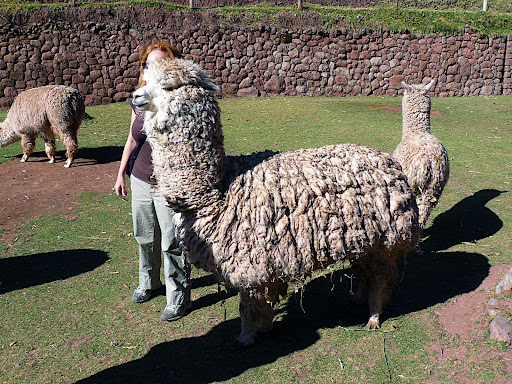
Speaking of which, our next stop, the llama preserve/craft cooperative that set the lone female on the tour into a 45 minute bout of constant cooing, showed the other extreme: amazing handiwork, great designs, but at prices that made my Bay Area accustomed eyes water. Wall hangings for many hundreds or thousands of dollars, baby Alpaca pillows for over $100,.. and so on. Very interesting, but they’d probably make ten times the money if their customers wouldn’t just kneel over from sticker shock. Somehow, in every developing country I've been in, there are these few places where the prices are not only completely out of whack with the local economy--which is basically every store that caters to tourists, even if it's still cheap--but where the pricing is even out of alignment with what 99% of the tourists can afford, are willing to spend, or would have to pay if the same merchandise would be sold at a fancy boutique on 5th Avenue. Most of us don't go to Peru expecting to spend the price of a new car for a 3 foot square carpet.

Next stop Pisac, probably the most fascinating Inca town on the entire trip (I’m looking at you Machu Picchu). It sits high on a ridge over the river and the new town and unlike MP and Ollyantaytambo, you can see the signs that people actually lived there for hundreds of years like groves worn into the stones from people walking over them, buildings from different eras, rich houses, poor houses, barracks and so on. Unfortunately, we only spent a few hours here. Fortunately, the next stop was an empanada stand and the crafts market in Pisac. Here prices were 1/40th of the shop we went to in the morning, and the things way more authentic. I bought some nice silver pendants, and--the coolest thing ever--tiny handmade beads formed and painted like gaudy human skulls at 3 cents each. Voodoo bracelet, here I come.
After a long drive through the agricultural heartland, we arrived at Ollyantaytambo, the last--and unfinished--mayor Inca town that guards the entrance to to valley from the jungle and the Machu Picchu area. Unlike Pisac, it really is unfinished to the point where some of the gigantic stoned are still left of the ramps leading up to the their intended position. On the bright side, it’s also the only place where the Inca beat the Spanish--at least until they came back with reinforcements. The town underneath it turned out to be the only remaining largely unchanged Inca-designed town in Peru and a fascinating place for exploration on the next day, but the vibe that night was a bit dicy. Maybe just because I was totally wiped from the drive and the walking up-and-down mountains thing, or it was that the guide told the two girl joining back up with us in the hotel after one collapsed on the Inca trail.
It’s also here that I had the once a trip OMG WTF moment when I watched the aforementioned ox plow--ironically Ollyantaytambo is also the most overpriced town in Peru thanks to the isolation and the tourists. It even beat Aguas Caliente, the jump off point to Machu Picchu where some overbuilding and competition has driven the prices down to a more palatable level. Dinner at the hotel was the most expensive meal of the trip and it wasn’t even that good. But I got the picture of this hummingbird outside my room, so all is good.

Sunday, July 20, 2008

Cobbler!!

Baking is a very precise art, and bakers shouldn't be rushed. Unlike when you invite someone over for lunch on a whim and are stuck for desert with only blueberries and the stuff in the pantry.

5 minute fridge-pantry blueberry cobbler:

1.5 inches of blueberries in a baking form
1 tablespoon cornstarch
some sugar

top with
1 glug of self raising flour with a bit of baking powder.
1/3 of the flour in brown sugar
1 handful roasted salted almonds (takes care of the 'pinch of salt' in the recipe)
1 egg
milk to thin
3 pieces of butter
all processed in a mini-food processor to "crumbly"

Bake in toaster oven at 425 until done. Server with whipped cream--or if you are out of it like I was, yogurt with agave syrup.

Saturday, July 19, 2008

Found bukkit!


You're too high on a mountain, when helicopters fly beneath you.

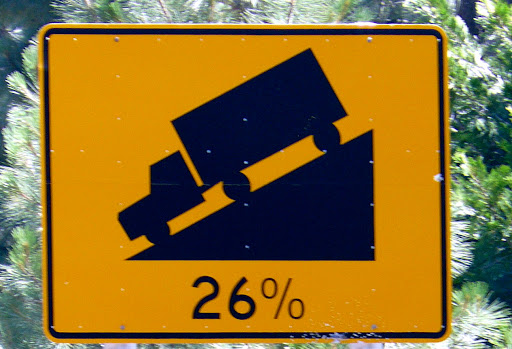
The don't have signs like this in Maryland

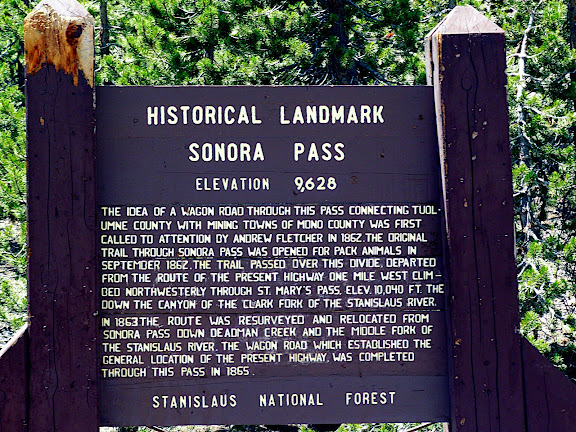
On the way to 9628ft......or 9624ft high Sonora Pass
Anyway, steep here. 

Friday, July 18, 2008

Come se llama? Llama!

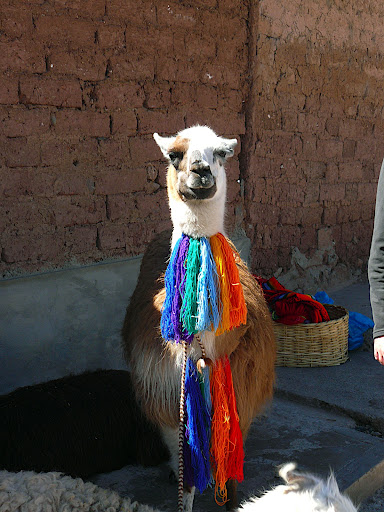
Dressed up llamaRasta llama

As big as Cynthia llama

Camel Lights llama*

Too cute for its own good llama

Prom queen llama

*Actually, that's a guanaco.

Thursday, July 17, 2008

Saksaywaman


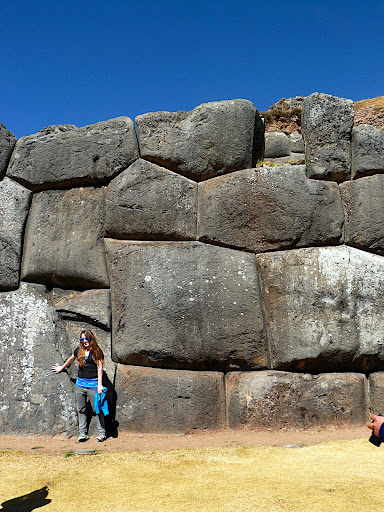
After going through the in-town attractions like the sun temple (now part of a Dominican monastery), the Plaza De Armas, and the cathedral, we got up the mountain to Sakaywaman—the big Inca fortress/temple overlooking Cusco. Absolutely fascinating, and looks a lot like Mycenae with the huge monolithic stone walls. Unlike Mycenae, the excavation is still in full swing, and according to the professor, they just discovered that the area is three times larger than they thought.
Sidenote 1: It's actually pronounced sexywoman (yes, there is a t-shirt, and no, I didn't buy it).
Sidenote 2: The camouflaged "refugees from Spamalot" PortAPotties made me laugh.

Natural remedies


Every hotel in the Andes has big thermos cans of coca tea 24-7 --with our without supplemental leaves. It really really helps with the altitude headaches. I didn't get to chew any, but the Inca trekkers in our group got a wad on the first incline and never stopped until they hit level ground again. Nobody went to the next step: brown guinea pigs and a shaman.

Cusco

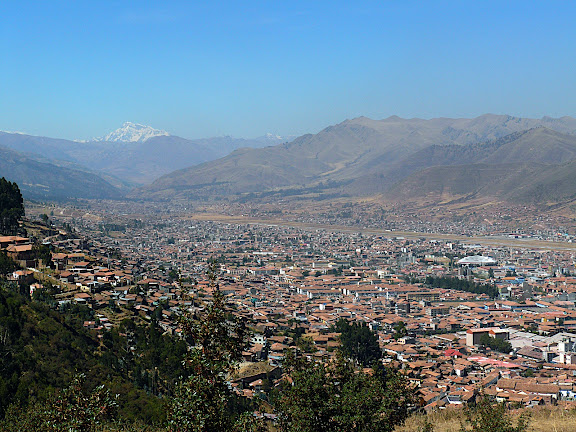
Puerto Maldonado to Cusco is only a 30 minute flight, but drops you into an entirely different world; a semi-desert about 12000ft above sea level. The first thing that hits you is a certain shortness of breath while schlepping through the terminal. The second is the kangaroos: Cusco has a reputation as the pickpocket capital of Peru, and some guides have been suggesting that tourists wear their backpacks in front to discourage slashers.

We didn’t really have a problem, except for an almost comical incident where a 10 year old boy tried to grab a camera. When the owner didn’t relinquish it, he dropped on the floor and hand an angry crying fit.

This is not to say that it might not be a problem; the rich touristy parts and the slum-like areas where the refugees from the 1990s civil war reside are only a few blocks apart.

And the gulf between rich and poor is huge. We managed to get a professor from the university as tour guide—he does the work because he makes more in a half-day of guiding than in a month on his normal salary ($200/month). So yeah, we tended not to o out alone at night.
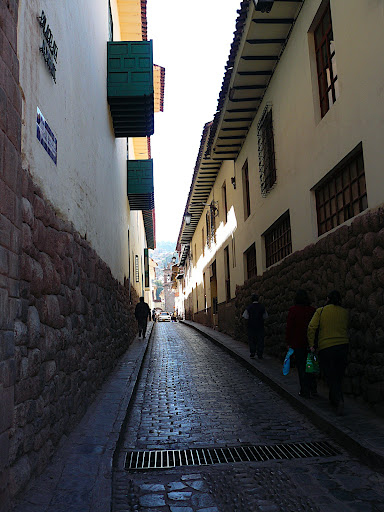
I somehow imagined Cusco a bit more grand and Incan, but since the Spanish build all their buildings on Inca foundations, so except for the huge mortar less walls, many things are somewhat hidden.

The hotel for example went from 8 feet of Inca walls on the ground floor to Spanish colonial on the higher walls.
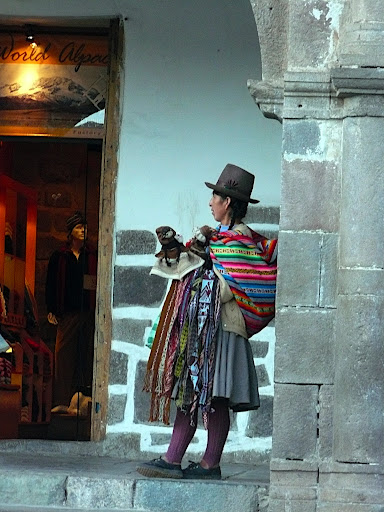
Another thing that cut the Incan flair, but at the same time probably decreased the crime rate, is that the Peruvian government banned street vendors from the main square a few years ago. Now all of the crafts vendors are down in a huge warehouse a half hour walk away. We went down there on the second day and stocked up on amazingly cheap hats, belts, scarves, and pendants. Some obviously went a bit over the edge.
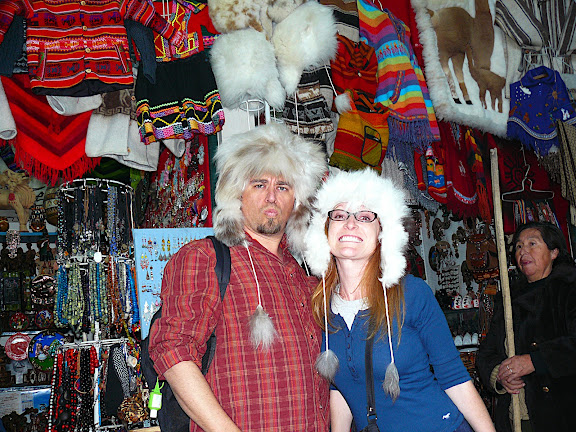
Tip for the future: buy clothing items here, but artisan stuff in Pisac. The quality and choice is much better.

Still somewhat unable to get Quechan food: Peruvians seem to live of pasta, fries, grilled chicken and … . On the whole trip, we ate maybe three of the 4000 different kinds of potatoes and quinoa.


Wednesday, July 16, 2008

Why Tony Bourdain and I hate backpackers

Thank you Lonely Planet. After almost 40 years of traveling (my parents dragged me out at 5 months), I am still baffled why millions of people spend time and money to go to exotic places just to try and emulate home. Americans storming the McDonalds at the Spanish Stairs, Germans going for Wuerstel and Kraut in Thailand, Brits bemoaning the scarceness of Kippers in the Western Sahara, Canadians going into comas after scarfing down beach side Poutine in 100 degree heat St. Maarten...

P.S. Guinea pig has the taste and texture of bicycle inner tubes. Alpaca's pretty good, though. And raw fish in developing countries doesn't kill you.

Dice onions faster than the CIA

OK, kitchen dork moment: I figured out a way to dice an onion faster than the French/CIA technique.
  1. Cut off the top and the stem of the onion
  2. Cut the onion in half
  3. Peel off the outer layer, unlike in the stem-on method, it comes off easily in one piece
  4. Put the onion halves on the cutting board flat side down
  5. Turn 90 degrees and slice each half into "almost moons", leaving about half an inch at the end facing away from you.
  6. Turn 90 degrees and dice, starting at a slight angle to get a radial pattern.
What makes it faster:
  • With the CIA method, peeling each half takes longer, because the skin is still attached at the stem end.
  • Moons is faster than the CIA stick pattern because you can slice across instead of forcing the knife straight down
  • You don't have to make the horizontal cuts before dicing
  • The onion doesn't start to fall apart after the horizontal slices
What makes is safer is that you never slice towards your fingers like you have to when making the CIA-style horizontal cuts.

This works especially well when I do micro dice like for lightning gyros:

  • Cube some meat
  • Brown quickly in olive oil in a hot skillet
  • Pepper, salt, add some oregano
  • When the oregano gets fragrant, deglaze with a few tbs broth or whatever is at hand. Turn off.
  • While the deglazing liquid cooks down, mix 1/2 cup of pre-made or leftover tsatziki with a bit of yoghurt, good olive oil, and 1/10th inch diced tomatos, onions, and cucumbers. Adjust salt and pepper. (If you have no tsatziki, use yoghurt and add some crushed garlic and lime juice).
  • Serve meat on toasted flour tortilas or pita with a bit of the "salsa"

Sunday, July 13, 2008

Pictures

I uploaded about a third of my Peru pictures. I haven't had time for a lot of photoshopping yet, so some pictures look pretty raw.

Friday, July 11, 2008

You call this a vacation? Part 2: Jungle Fever!

At the end of the day, we hiked 25 minutes in total darkness to reach the locally indigenous-run lodge, an awesome complex of open air tropical wood rooms and salons in a somewhat Thai style. In the best British Raj tradition, we got a few drinks, dined on Peruvian dishes, fired up the kerosene lamps, and had a coooooold shower before heading out back on the river to search for caymans at night. Unfortunately, we didn't find any, but one of the group managed to step on some soldier ants and got a bunch of nice bites. While the outboard engines on the canoes we used for going up the river were pretty standard Hondas, the one on the lodge canoe was an amazing contraption of a 1950s rotary engine, 20 feet of galvanized steel pipe, a few pieces or rebar, and a bent nail to faster the screw. (sidenote: it occurred to me later that driving a canoe up a jungle river in almost complete darkness is not one of the safest activities). The next morning (5:30 or so), the guides kicked us out of bed, force-marched us 20 minutes through the dark jungle and up a 100 foot tower contraption to watch the sun rise over the Amazon. Definitely one of the top 5 sunrises of my life.By the way, sleeping on an open platform in the jungle provides great entertainment with the wildlife noises in the background, after darkness you can let them lull your to sleep as they gradually die down. Unfortunately, the night was a bit spoiled by the woman somewhere in another room coughing her lung out the entire night--I have no idea how (a) she didn't expluse all her lung tissue and die and (b) nobody got up a smothered her with a pillow.

All in all, the Amazon seems less dense and--at least at this time--colder than Belize, Thailand, or Africa. But it has the same amount of biting and stinging bugs. Thankfully, DEET and permethin are a wonderful combination to keep the bite count to dozens instead of hundreds. The rest of the day was spent hiking through the jungle with local guides who did a great job of pointing out uses or local plants, dyes, and other natural resources. We also fit in a short boat ride using a raft with a peculiar Peruvian "cayman tail" rudder of a type I've never seen, but that worked extremely well. In the evening we went for a soccer game/river swim after assurances that the stretch of river was reasonably clear of piranhas, caymans, and these nice little fish which creep up the urethra and then anchor themselves with bony hooks.Lunch and dinner were lavish affairs with pork, local fruit juices, and veggies from the highlands. Ironically, while all the food was great, the far and away best dish was a chickpea stew. They also provided the first exposure to coca tea, which tasted a lot better than the instant coffee that seems de rigueur in all large coffee exporting countries. Couldn't they just keep some of the decent stuff?

Jungle tip 1: If you bathe in a river where you can't see the bottom, throw in some dirt and see if anything reacts before going in.
Jungle tip 2: Don't roll up you pants past the point on your legs where you stopped slathering on DEET. Once group member got dozens of bites on a two inch ring around both legs.
Jungle tip 3: Even if the current doesn't seem that strong, check your bearings every 30 seconds or so.

The next morning we got up at the customary time to take an icy shower and then get back down the river, up the dirt road, and onto a plane to Cusco.

You call this a vacation? Part 1: Welcome to the Jungle!


I got to SFO at 12:10AM for the 1:45 flight to Lima via El Salvador on TACA (unrelated side note, the TACA and LAN planes were all on time, clean, spacious, and served edible food, including killer Aroz con Pollo. Why can't US airlines match that?) to Lima via El Salvador. Most of Lima is a dump and I smelled the sweet coal fire smog for the first time since my last visit to the GDR 20 years ago.

Nice hotel in Miraflores, a really nice and affluent part of Lima. and we immediately went for food and Pisco Sours with the tour guide to get over the shock that we'd be getting up at around 5:30 for the next few days. The next morning we flew to Puerto Maldonado in the Peruvian Amazon, went on a bumpy 45 minute ride on a dirt road to the boat launch, and a 4 hour motorized canoe ride past gold mining rafts,
cargo boats,
and interesting bathroomsinto the deepest Amazon outback. I'm always surprised how not tall most of the jungle actually is: most trees are around 40-60 feets and the real giants are hard to find.

If parts of Lima were poor, Puerto Maldonado was dirt poor and going up the river, the standard of living rapidly went down to pure subsistence farming level. No roads, no markets, and many people cannot even afford the prices to get their products to market on the river canoes. Everyone was very friendly, though, and it's somewhat disconcerting that the same people burned down the governor's building and attacked police with bows and arrows barely a week later. On the plus side, there was also hardly any trash, since even an empty bottle is valuable.


Wednesday, July 09, 2008

Early morning clouds

I'll post more pictures over the weekend in a more orderly fashion, but for now.

Offerings


An ancient Incan fertility offering.
  1. Yes, it's exactly what it looks like
  2. This thing is made out of stone and freakishly heavy...about 4 pounds