On the way back from Big Sur I stopped at the Santa Cruz
Bookstore--together with Powells and Elliott Book Company probably the
best independent bookstore on the West Coast, now that so many like
Cody's have bitten the dust. They're comfy, have a good selection, do
author readings and stuff, and this nice slightly rundown feeling. I
browsed for a bit and found $60 of books I liked. More out of
curiosity, I SnapTell'd them; thinking to myself "I'll pay the extra 8
bucks or so to keep this independent store in business. Turns out the
Amazon price for the lot was $34, with two independent stores selling
one new and one slightly used copy for $16+$8 in shipping.
Etiquette question: am I a bad person for not forking over 36 dollars
for the pleasure of browsing the store for fifteen minutes?
And the larger question--wouldn't it be more economically feasible for
SCB and other stores like this to get their prices somewhat in line
with the online pricing? Obviously, they can't price match Amazon, but
charging 70% more for the same service will drive people out of their
stores who would contribute to keep a local bookstore. I think it
they'd be within 20%, many customers would gladly pay that, especially
in beach front California. I spend $85 at Borderlands a couple of
weeks ago, even though I could probably have saved ten or fifteen by
going through Amazon. And I feel good about it, because it keeps
Borderlands in business.
P.S. I spent the $36 difference at Bugaboo, Gelato Mania, and Chefworks across the street, so they went to local businesses. (I think independent, but I could be wrong about Chefworks)
Sunday, April 19, 2009


Wednesday, April 01, 2009
The fourth estate

I wanted to write a long post about how the newspapers' and press' problems are more because of lack of quality and the fact that instead of reading the local paper now everyone can pick the 3-4 best in the world, but this picture sums the flight from quality better than I ever could. The 20 red cycles are press photographers, the 5 green ones are protesters.
That's not reporting, that's performance art.
Sunday, March 29, 2009
California without the tourists
 OK, there were tourists, but it wasn't crammed like in summer. You could take pictures without a gazillion people in it.
And thank god for aloe.
Saturday, March 28, 2009

Sunday, March 22, 2009
Sunday
Froze my ass off on Land's End Trail. When will I finally learn that it's always much colder than it looks out there. Nice picture opportunities, though.
- Had lunch at Dosa with some friends. Best Indian food anywhere--including India. And the service is so much better.
- Listened to the sales guys at Borderlands rant about Zack Snyder movies and Beowulf for half an hour. They're not fans.

Tuesday, March 17, 2009
Caring for veterans
My yuppie/dink/soccer mom gym is thankfully mostly clear of the usual annoyances like the groaning iron pumpers and yelling high schoolers. And the hookers who come here for the after work executives are a nice distractions. Also, except for Batty, the woman who shows up every morning at 6am with two duffels of swimming paraphernalia like three pairs of goggles, four pairs of flippers; takes over a lane for 5 hours and glowers at people for "making waves" two lanes over, it's also mostly free of the certifiably exercise insane.
The one unique danger, especially when the light in the sauna is turned off, is Sergeant Tripod. He's a friendly, tiny, black ex-military guy with a name sake a knee-long appendage. The nicest person ever, but he's also a poster child for post traumatic stress disorder. Anyone opening the door gets greeted by a parade ground quality "Good MORNING, SIR!" after which he resumes his in-sauna exercise regimen of nude pushups, nude squats—punctuated with a growled HUUUUU-RAAHHHHH at the end of every set—and nude power stretches that elicit unearthly groans from him. All the while, he keeps up small talk that can be heard right past the hot tub and the showers into the locker room.
Since he's a nice, shy person, nobody ever says anything.
But this morning, he added squat thrust. So, how long does one have to wait politely before leaving?
Saturday, February 28, 2009
Bhopal and Sanchi
 This was actually the third stop in India, but until now, I haven't gotten around to posting the pictures. Bhopal was the first real major Indian city in a sense that it was neither Delhi, nor the somewhat touristified Agra (not that that meant that Agrans didn't carry dead bodies down the street, or had water buffalo roaming the town, or similar. But Bhopal is much larger, and much less accustomed to non-Indian.
Ironically we didn't see much of the town center--except creeping the half mile from the train station to the edge of downtown where traffic broke up at far less than walking pace in the bus. About 200 meters from the station entrance, we got completely stuck and savored 15 minutes of this peculiar Indian trait of not, never, ever, backing up, even if it would mean that everyone, including oneself, could move faster 10 seconds later.
 After checking in, we hunted down a not completely overpriced tuk tuk to go to the state museum that the guide, the hotel staff and the drivers recommended only to find out that it was closed for <drumroll> Christmas. Obviously, the museum staff were the only Christians within 500 miles.
So we spent the evening at the famous lakes that Bhopal was named for.
 Since I threw out my knee a coupel of days before I stayed on the shore and watched the paddle boaters and getting my picture taken by the Indians who've come to enjoy and evening on the water. Very cool and very interesting. All the computer science and engineering students wanted to hear about how many Indians work at my company in California.
In a nod to the rising middle class, the lakefront had an amazingly good cafe with great views, fab cappuccino, and ice cream that didn't kill anyone.
Back at the hotel, we got matter-of-fact-ly invited to an Indian wedding. Great times, the bride and groom were from Pitt and CMU, the best man from Linköping, and the rest from assorted universities, and the bankers, business owners and doctors of Bhopal. The hospitality is incredible and slightly embarrassing. I am not confident I would invite 30 Indians who stumble into my reception.
The next morning we left for Sanchi in the morning smog and saw the other side of Bhopal: people camped on the roads under ripped plastic tarps, children stumbling up and down smoldering trash heaps; and right in the middle the new technical university.
Sanchi (pics) was the first of the really historic places in the middle of effing nowhere, and at the end of the IMO worst road we had in India. But everyone on the trip had their particular favorite stretch of Indian road building, so it probably was just middling. So I'll only mention in passing that it took us over two hours to drive the 30 miles.
 The remaining temples are amazingly well preserved, especially considering that they were build between 300-70 BCE and survived 2000 years of rain, heat, and wind. For sandstone, that's quite an achievement. It was probably helped that they were abandoned and mostly forgotten after India reverted back from Buddhism to Hinduism.
Except for the temples, two of which looked suspiciously Greek or Egyptian, the only thing is the tourist shop where we pissed of one of the proprietors by pointing out to him that he tried to charge twice the government mandated prices that were clearly printed on the packaging.
And then it was back to Bhopal and another 10 hours on the bus to Mandu.
Tuesday, February 24, 2009

Sunday, February 22, 2009
What are these men doing with that horse?
 10 hours into a backbreaking bus ride--on the "good" road, the one from Khajuraho (pics) to Veranasi is so gruesome that we flew the 200 miles the next day--we arrived at the outskirts of Khajuraho and the hotel with the worst service in India. Lunch and check in took two hours, and involved a rousing game of magical supplies: some rooms missed soap, most towels, and some, like mine, any semblance of sheets. As the hotel manager explained so nicely "beds don't come with sheet, we have blanket", scratchy, dirty, moldy blankets that had a few decades on the newish building. After 30 years of traveling, I'm fairly hardcore and quite a few others like the Canadian couple who go hitchhiking in Tanzania even more so, but after near mutiny everyone was at the bus 20 minutes early the next day to get the ef out of there.
 Khajuraho's main and only attraction are the famous 10th to 14th century Tantric temples...
 ...with their very explicit depictions of the 85 or so positions in the Kamasutra...
 ...and a few that Vatsayayana had never even heard off.
  Some friezes are very embellished. Indian girls must be so disappointed on their weeding night after seeing this:
 The quality of the work is astounding, and unlike other temples and churches, it's not a bit or relief work here and there, the entire temples are covered from the foundation stones to the roof.
 Many or most reliefs are actually showing normal life as well or better than Egyptian hieroglyphs, and don't make you go "Done that"..."haven't done that"..."should try that"..."WTF? How on earth do you do THAT?!?".
This one also shows up in Dumbo.
 The temples that didn't quite make the UN world heritage list are still in full swing and worshipers streamed in for the evening puja.
 This being M.P., the temples obviously close at dusk, so we were back on the streets in the half-block of downtown and in the middle of the most annoying touts I've encountered since Marrakech. At one point, a few of us bumped into each other and compared our following. I shared first place for five pushing, shoving and come-my-store-good-bargains yelling youths. Funnily, the best way to escape was going into stores who's owners did their best to keep them out so they could cheat on the commission.
In an amazing show of chutzpah, after pissing me off for the best part of an hour and not heeding a single "fuck off", the most obnoxious "student" tried to charge me 100Rs for the "tour of the city".
Weirdly, this oversold, unfriendly, and overrun town also offered an amazing revue of Indian folk dances at night. Touristy, yes, but the singer and dancers were really really good. Of course, no such event is complete without an elderly German making a complete idiot of himself by repeatedly leaping out of his chair into a prone position in the aisle, moaning audibly from the shock reveberating from his arthritic knees hitting the concrete, to capture the "perfect" shot with a $50 POS camera and no flash.


Monday, February 16, 2009
It's still raining


So here are some pictures from last week. Yeah, Cindy, this is a jogging path....
Sunday, February 15, 2009


Mandu 2
 With the exception of the couple of dozen tourists per day, the plateau's economy is entirely agricultural. Women go to wells and carry water for miles,
  and the men fish the lakes (or more probably old palace fish ponds) in small boats or just casting their nets standing in the muddy water up to their chests. In a sign of modernism, they arrived at the pond 3-4 on one Honda Hero motorcycle at a time.
 Mandu had the friendliest and most open people I met during the trip. Nobody begged, I got invited to sit down with a family when I walked out to the fish pond in the morning...I very selfishly hope that nobody improves the road there anytime soon. As it was, the bus almost didn't make it through one of the gates.
Since it's so out there, the hotel was a typical M.P. state establishment...wonderfully laid out, with a distinct 50s vibe, and partially falling apart even as new parts were built. I'd live to meet the landscape architect who put my bungalow at the end of a natural drainage ditch that the guide and I had to scramble up and down to get from our rooms to the reception/restaurant/bar.
And it was naturally overrun by monkeys. Monkey pee can't be good for walls.


WBTPITMOFN, Part 2
 Mandu, nowadays a tiny town of 8000 and 50% literacy the end of the road, was the Raj and Afghani capital of a large part of northern India for a few hundred years. Like Orchha, it is in the middle of nowhere--at least this time for a good reason its 23 miles of walls and battlements sit on a mountain ridge that make the place both cooler, and pretty hard for mounted troops to assault. Also like Orchha, only the amazing palaces,
  mosques,
  caravansaries and graves are left...no sign that normal people lived here. I'd so love to start an archeological dig here.
 The Afghani palaces are of unbelievable splendor surrounded by huge artificial lakes and water tanks--both because of the erratic supply and to make the 120F summer heat more bearable.
 The Ship Palace, so called because it sits between a lake and a water talk like a huge ship was undergoing restorations...from the concrete mill below, the building methods haven't changed much since antiquity.
 The great audience hall, stripped of the carpets, gold and decorations...and still very impressive.
Monday, February 09, 2009
Grades of Poverty

A friend of mine sent me a link to a web site where a precocious middle class trust fund baby chronicles his experiment of living in poverty. He moves to a new city with $25 to check the claim that one could "get an apartment, a car,... by just working hard in a minimum wage job". The author suffers through hardships like not having a cell phone, only being able to watch network TV, and eating Rice-A-Roni, one of the more infamous San Franciscan contributions to the culinary fabric of the United States.
My insensitive response was "everyone who talks about poverty with a cell phone can suck it."
I feel for the poor in the US, but on a global perspective, they are among the luckiest 5-10% of humanity.
But what is poor? I mean really really poor?
One of the first things that come to many people’s mind when thinking about depraving, gut wrenching poverty--if they are not thinking sub-Saharan African refugee camps--might be the infamous Indian rickshaw driver ferrying huge loads or fat tourists like me on rickety bikes for a few pennies an hour.
My education in poverty Indian style started when I hired one for a tour of Old Delhi, and paid him 120 rupees (about $2) plus a tip for two hours of excellent guiding. He seemed happy enough, but it was still hard work. On the tour, I saw carpenters waiting for work on the road side, and porters and flower pickers who clearly couldn’t make a huge amount, but I had no clue how much money they made or didn’t make. 
A few days later, I found out that I obviously overpaid by a huge margin. The going rate for Indian tourists who hired rickshaws was about 150 rupees a day. (OK, I also negotiated no shop visits, so that was worth the extras. If you don’t, you’ll end up not touring the city, but carpet and craft stores that pay the drivers a 5% commission on sales.)
$3 for an 8 hour backbreaking tour in Delhi traffic must be about as bad as it gets, right? Turns out, not even close.
Towards the end of the trip in Varanasi, we once again hired rickshaw drivers for a multi hour tour, and I got somewhat of an education from my driver who was the leader of that particular rickshaw posse. The most pushy of my fellow tourists had negotiated a 20Rs/hour rate with the "facilitator" in front of the hotel. (I’ll rant about the "pay local rates and don’t tip" tourists later).
From these 20Rs, 30% went to the facilitator and 20% to the owner of the rickshaw. So, Considering that children were selling 100Rs postcard books to tourists, 25 cents/hour must be as bad as it gets, right? Well, my driver also had a nut fixed by a roadside bicycle mechanic who got 5Rs for his work, and he’s sitting by the road all day and might get one customer an hour. So, 5Rs an hour is really bad?
Turn out, not really. My driver was proud that the 200-300RS or 4-6 dollars he made a lead driver during a 16 hour work day enabled his family of six to live in relative comfort compared to his former job as a carpet weaving instructor that paid 500Rs a month, or 20RS per day.
(Unrelated side note: the really poor in Indian cities don’t beg from tourists. Since you can make a lot more that way, most areas are pretty tightly regulated and swarming with the ones who know a smattering of English, and don’t run afoul of the ones who manage the begging. My come to Jesus moment was on the Ghats in Varanasi when I recognized one of the beggars as the manger of the shawl store Veerle and Carrie had just dropped about 1500Rs. Along Connaught Square in New Delhi, 90% of the ones asking for money were fairly well dressed English students--or kids that claimed they were and asked for money for books.)
So, 20Rs a day is rock bottom? Definitely not, if you make 20Rs, your extended family can probably spend 25 days combined salary on a cremation on the river Ganges. But as I mentioned in my last post, people move to Varanasi to die and get a free cremation because their families can’t afford it. So the ones who live in the ruined buildings charitably called hospices must be poorer than that. And I think you can reasonably assume that a dooby wallah or washer makes less than an artisan like a weaver. A person who makes a living standing in the burning sun in a dirty river doing the backbreaking work of slamming clothing on a flat rock all day must be at the bottom of the poverty scale? What speaks against this is that these jobs are hereditary and enviously guarded, people fight to defend their slots on the river bank. The families literally sleeping on the streets and traffic circles in Delhi would probably kill for the opportunity. But even the families living under tarps along the roads leading out of Bhopal and whose children I saw digging through the smoldering trash heaps in the early morning fog moved there to escape rural poverty and are not moving back.
I think what’s really poor never hit me until we drove through the back of beyond in Madra Pradesh and families were living in 5’ by 8’ straw huts scattered in the fields.  Sorry about the image quality. This was shot off a bus bouncing along what was euphemistically called a "main road".
Of course, they were close to a major road and can sell a bit of produce, so there are probably still a few rugs below that on the ladder.
Sorry about the image quality. This was shot off a bus bouncing along what was euphemistically called a "main road". Of course, they were close to a major road and can sell a bit of produce, so there are probably still a few rugs below that on the ladder.
So, yeah, the guy too poor to afford cable can suck it big time.
Friday, February 06, 2009
Nightcap on the river Styx

Jumping a bit ahead in the chronology, the last stop in India was the holy city of Varanasi aka. Benares. Without going to the less wealthy parts of Mumbai or Calcutta, it's probably as extreme as India gets. The big attraction to Indians is that people who get cremated in Varanasi and have their ashes dumped in the Ganges get a free Don't Pass Go ticket to nirvana. The burning ghats (staircases down to the Ganges) are pretty pastoral with goats and cows wandering past the pyres and easing flower garlands and other leftovers, and remarkable non-smelly. This is largely thanks to the new custom of pouring some vegetable oil over the bodies to get the flame temperature up a bit.

But, it also means that many of the poorest faithful move to Varanasi to wait for the end. How poor? It's mostly people whose families could not afford to pay the 5000 rupees ($100) for the wood cremation, or even the 500 rupees for the electrical. We rode by some ruins that now house the waiting, often for years. Surprisingly, the number of beggars and touts was fairly low—much lower than in Delhi or OMG Khajuraho. And there were, for the first time on our trip, more than enough tourists to go around.The best views of Varanasi are from the river at sunset and sunrise, so we did boat rides for both. The morning one in the fog is especially eerie and in almost medieval silence. No motorized vehicles can make it through the tiny alleys that border the river, and only row and sailboats are on it. In the early morning darkness, it is like floating on the Styx.
But, it also means that many of the poorest faithful move to Varanasi to wait for the end. How poor? It's mostly people whose families could not afford to pay the 5000 rupees ($100) for the wood cremation, or even the 500 rupees for the electrical. We rode by some ruins that now house the waiting, often for years. Surprisingly, the number of beggars and touts was fairly low—much lower than in Delhi or OMG Khajuraho. And there were, for the first time on our trip, more than enough tourists to go around.The best views of Varanasi are from the river at sunset and sunrise, so we did boat rides for both. The morning one in the fog is especially eerie and in almost medieval silence. No motorized vehicles can make it through the tiny alleys that border the river, and only row and sailboats are on it. In the early morning darkness, it is like floating on the Styx.
 The evening has some additional appeal like the candles floating down and the glowing pyres, but the silence is scattered by the huge evening religious ceremonies piping prayers through loud speakers.
Great planning in India, part 21498: On new years day, the road department painted a huge "Happy New Year 2009" across the always congested main road. Then they roped off the two lanes around the inscription, completely choking off traffic.
Wednesday, February 04, 2009
Busy at work

Rowing the corporate ship like a bitch
(dear god, let this week be over)
(dear god, let this week be over)
P.S. A huge shout out to the people at NeatImage. Their Photoshop noise filter is amazing. This picture was shot at 1/10 second and 3200ISO about half an hour after sunset. Standing on a rickety boat.
Sunday, February 01, 2009
Building stuff
Bamboo and stainless steel laptop station
- 23"x18"x1.5" bamboo cutting board on sale at SLT: $25
- Adjustable table leg from Ikea: $10
- 4 drywall anchors, 8 wood screws: $3
- 2 4" corner braces: $2
- 10 minutes with a power drill: $0
- Buying all the hardware before starting for the first time in my life: priceless
Wednesday, January 28, 2009
WBTPITMOFN--Or Who Build This Place In The Middle Of Fucking Nowhere
The beauty of India: colorful dyes for offerings next to cows eating garbage.

Odd fact: many of the formerly great towns we visited are miles and miles from population centers and show no obvious signs that anyone except the kings, maharajas, or priests ever lived there. Orchha, Sanchi, Khajuraho, and Mandu were all capitals of princely states, or important religious places, and all that's left are the palaces and temples, with a few small streets and a few thousand people who would never have been enough to support the splendor and idle rich who lived there in the past. No sign of "normal people homes". In the case of Sanchi, it's understandable, because the stupas are leftovers from 1000AD or so, but Orccha's palace was inhabited by the Rajas and the Mughals well into the time of British India.
Orchha (pics) was the next stop after Gawilor, and definitely the nicest hotel during the entire trip. An old, renovated royal hunting lodge with only 29 rooms and probably twice as many servants straight out Richard Attenborough's central casting. Even the electrical installation and switchboards were 19th century originals.
Sidenote: Indian electrical systems are a miracle of Rube Goldberg design: Every electrical device has it's own switch. If the room has 5 light bulbs, 3 outlets, and a fan, you have 9 switches, and they are arranged in a single panel or a cluster of panels according to the following rules:
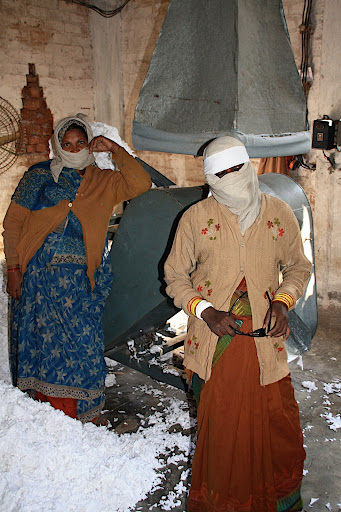
In a nod to modern India, we visited an EU-sponsored artisan paper factory for single women who would have no other means of supporting themselves...at the same time uplifting and depressing. But they were definitely better off than without and the place had a wonderful quiet and purposeful vibe.
 The second night in Orchha was Christmas Eve and the hotel pulled out all the stops by hiring a illuminated dance floor and a DJ. If you've never celebrated the birth of the savior by rocking out to Who Let The Dogs Out in Hindi, you haven't experienced the true spirit of Christmas. Our tour guide--who wiped out on a motorcycle the night before--greatly enhanced the production value by demonstrating why you shouldn't mix pain meds with alcohol: He break danced through three or four repeats of the one and only 80s dance CD the DJ had handy.
Odd fact: many of the formerly great towns we visited are miles and miles from population centers and show no obvious signs that anyone except the kings, maharajas, or priests ever lived there. Orchha, Sanchi, Khajuraho, and Mandu were all capitals of princely states, or important religious places, and all that's left are the palaces and temples, with a few small streets and a few thousand people who would never have been enough to support the splendor and idle rich who lived there in the past. No sign of "normal people homes". In the case of Sanchi, it's understandable, because the stupas are leftovers from 1000AD or so, but Orccha's palace was inhabited by the Rajas and the Mughals well into the time of British India.
Orchha (pics) was the next stop after Gawilor, and definitely the nicest hotel during the entire trip. An old, renovated royal hunting lodge with only 29 rooms and probably twice as many servants straight out Richard Attenborough's central casting.
Even the electrical installation and switchboards were 19th century originals.Sidenote: Indian electrical systems are a miracle of Rube Goldberg design: Every electrical device has it's own switch. If the room has 5 light bulbs, 3 outlets, and a fan, you have 9 switches, and they are arranged in a single panel or a cluster of panels according to the following rules:
- Every switch has to be as far away from the device it operates as possible.
- Neighboring switches cannot have similar functions.
- Lamps and fans need to be connected to more than one switch, so only combinations turn them on or off.
In a nod to modern India, we visited an EU-sponsored artisan paper factory for single women who would have no other means of supporting themselves...at the same time uplifting and depressing. But they were definitely better off than without and the place had a wonderful quiet and purposeful vibe.
The second night in Orchha was Christmas Eve and the hotel pulled out all the stops by hiring a illuminated dance floor and a DJ. If you've never celebrated the birth of the savior by rocking out to Who Let The Dogs Out in Hindi, you haven't experienced the true spirit of Christmas. Our tour guide--who wiped out on a motorcycle the night before--greatly enhanced the production value by demonstrating why you shouldn't mix pain meds with alcohol: He break danced through three or four repeats of the one and only 80s dance CD the DJ had handy.
Subscribe to:
Posts (Atom)